
Evolving roles
Product designers learn prompt and model behavior patterns, content designers shape assistant behavior, and researchers evaluate real model output.
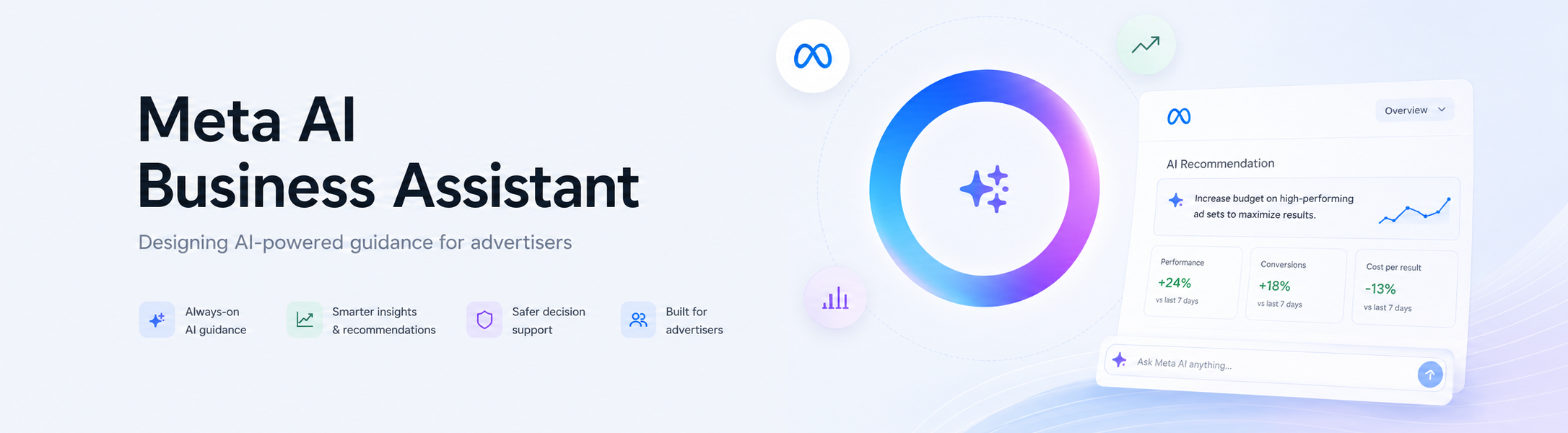
I joined Meta as a Senior Design Manager on the Ads Experience Platform group, leading design for Meta AI Business Assistant, an effort at the intersection of AdTech and AI.
The mission is to bring AI-driven insights and assistant-style workflows directly into the tools advertisers use every day, so that creating, managing, and optimizing campaigns feels less like operating software and more like collaborating with a knowledgeable partner.
Ads is Meta's largest business, and the surface our AI work has to earn its place on. At this scale, small experience decisions ripple across a very large advertiser base.
Leading a 15-person design organization across MAIBA, Ads Manager Mobile, and usability.
The Ads Experience Platform design group was organized around two core product pods — Meta AI Business Assistant and Ads Manager Mobile — supported by specialized craft anchors in compliance, business reporting, and usability. I designed the org for clarity, scale, and decision velocity.
The scale behind every campaign.
Meta is building AI products for many surfaces and audiences. MAIBA is the assistant built for advertisers, living inside Ads Manager and Business Support Home rather than in a separate chatbot destination.
MAIBA is an always-on generative AI chat assistant that gives advertisers personalized guidance, campaign insights, recommendations, and account issue support inside their existing workflow.
No tool switching or copy-pasting campaign context into a separate chatbot.
Performance shifts explained in plain language, not buried in metrics tables.
Personalized recommendations based on each advertiser’s campaigns and goals.
Instant diagnostics for routine issues, with escalation paths when human help is needed.
Advertisers were increasingly dissatisfied with traditional support: advice felt generic, continuity was poor, outreach was intrusive, and resolution could be slow. Some advertisers had started turning to third-party AI tools, moving sensitive campaign context outside Meta’s ecosystem.
Support advice often failed to understand the advertiser’s actual business context.
Advertisers had to restate their situation as ownership changed across sessions.
Calls and outreach could interrupt the workflow instead of helping at the right moment.
Guidance was sometimes too broad or too late to support high-stakes campaign decisions.
Deliver personalized, always-on guidance natively inside Meta’s advertising tools, making the product clearly better than external workarounds while keeping data where it belongs.
This was our team's first AI-native business tool. We had no internal blueprint — the model layer was changing weekly, and we needed a shared North Star before moving too far into execution.
A five-day design sprint in Menlo Park brought together a cross-functional team to align on the vision, interaction model, and evaluation criteria.
This was our first AI-native business tool. The team needed patterns for an assistant that could reason, respond, and take context from live product surfaces.
Design had to communicate confidence, boundaries, and waiting states where model behavior was still evolving.
The sprint forced the right trade-offs early: user value, model capability, business impact, and operational feasibility.
The sprint produced a North Star vision. The months that followed turned it into a shipping product through capability frameworks, prototypes, research, model-informed iteration, and trade-off decisions.
A shared vision that defined what success meant for users, the business, and the system.
Guided by capability frameworks, research, and model-informed iteration.
Shipped capabilities with measurable impact and a foundation for scale.
Specific design decisions, prototypes, research findings, model behavior trade-offs, and outcome details for Meta AI Business Assistant are available for those interested — feel free to contact me to learn more.
✉ Contact me on LinkedIn or at keeprain@gmail.com.
In Oct 2025, we launched the beta of Meta AI Business Assistant (MAIBA) inside Ads Manager and Business Support Home.
MAIBA delivers personalized, proactive guidance that helps advertisers analyze performance, solve account issues, and take action—faster.
Using current and prior campaign data, the assistant can surface insights, compare results to benchmarks, and recommend improvements directly from the chat.
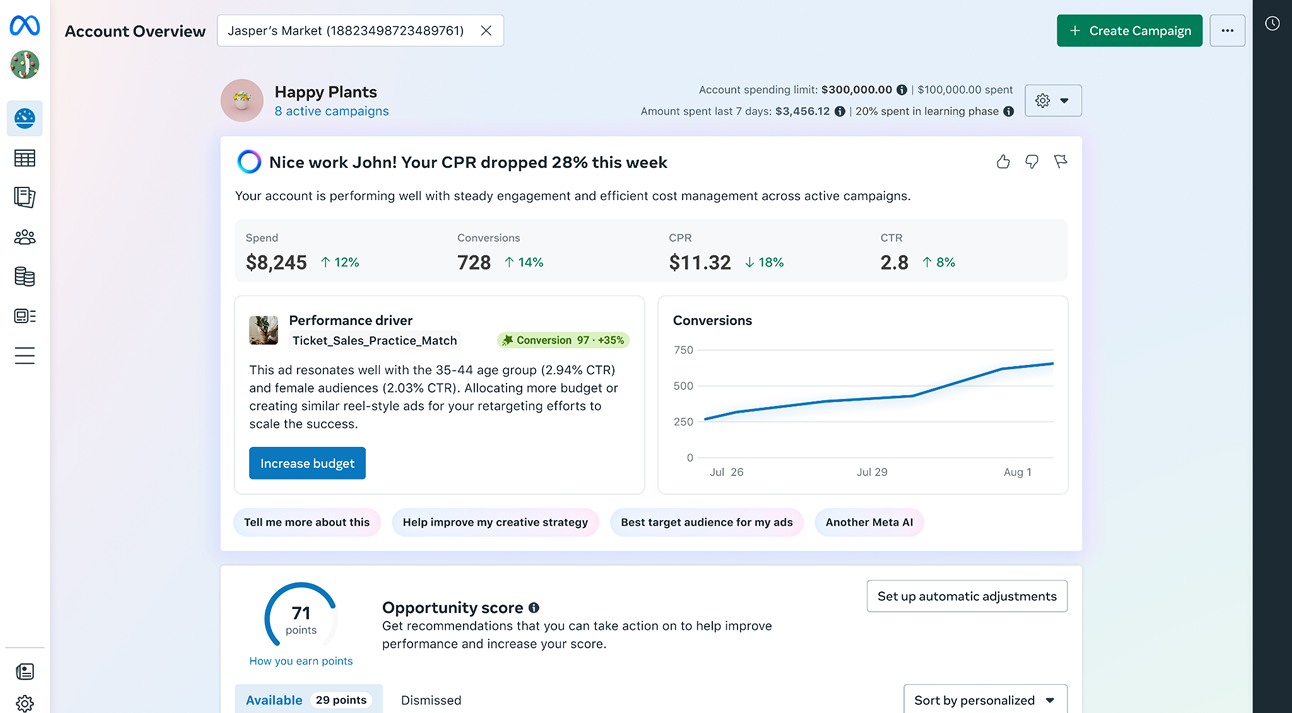
Early results from advertisers using Meta AI business assistant in beta.
for advertisers who applied opportunity score recommendations from Meta AI business assistant.
of common account management issues with Meta AI business assistant, which is currently in Beta.
estimated time saved on routine performance analysis and issue resolution.
average rating from beta testers on the quality and usefulness of recommendations.
Across this work, I developed a stronger point of view on what it takes to design AI products. Designing for AI is not simply adding a smart layer on top of a normal UI. The interface itself becomes a partner in a system of intelligence.
The design challenge shifts from "here are the features" to "here is a system that learns, suggests, adapts, and interacts."
Product designers learn prompt and model behavior patterns, content designers shape assistant behavior, and researchers evaluate real model output.
Critique shifts from "does the screen work" to "does the system behave," with live dogfooding and eval data as part of review.
Small cross-functional pods carry end-to-end ownership so the team can move faster without losing accountability.